
Separation Anxiety
Among the many potential bottlenecks in a brewery (pun intended), along with the primary one considered by maltsters, is the lautering process. The simple separation of wort from spent grains is commonly wrapped up in about 90 minutes on a typical brew day. Lautering is on the mind of the maltster because malt grist forms the structure of the filter that wort flows through, resulting in clear, particle-free wort. Unfortunately for brewers, this process is only simple in definition or brief description. When you begin digging into it, often when looking to increase efficiency or throughput, you may quickly find out just how challenging and complex lautering can be. Not only is this process complex, but you’ll find there are multiple systems with their own complexity contributing to its success or failure. Fortunately, the more complex a problem is, the more rewarding it is to overcome!
For Starters
Successful wort separation is the combination of equipment, good malt, careful preparation, and precise operation to create a problem-free, smooth-flowing stream into the kettle. Each component of separation plays a critical role in its success, and one incompatible adjustment or failure can lead to a difficult lautering process. Every brewery I’ve visited during my malting career has had a unique combination of equipment, ingredients, and processes, further multiplying the potential issues, obstructions, and solutions for improving the wort separation process. Since this is a blog, not an entire textbook, we’re going to attempt to keep it short-ish, appropriate for blog-length attention. I’m going to assume that most readers are more interested in working with the equipment they have and assessing and adjusting their process, rather than adjusting their budget to accommodate new equipment. To limit the discussion to preparation and practices, let’s assume you have established recipes using high-quality malt (from Briess).
Preparation
When considering the remaining aspects of wort separation, you should consider widening your scope slightly.
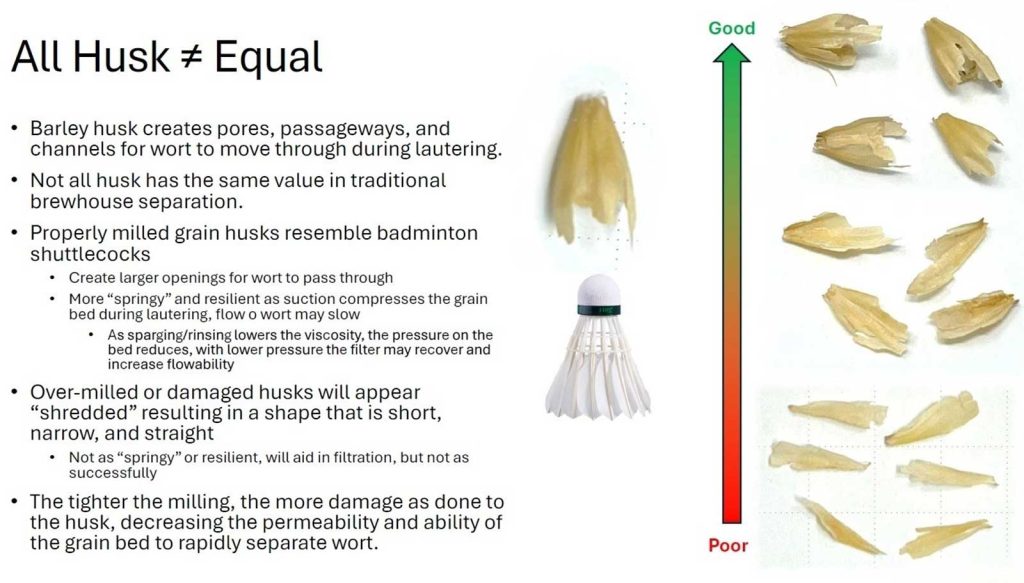
Malt receiving and handling systems are critical components in operations, and when they are working well, they preserve the quality and integrity of the grain. Maintenance is always critical to keeping these components running smoothly, limiting the damage to grain. This damage occurs disproportionately to the husk of the grain, and the husk performs a critical role during lautering as it creates pores and channels in the filter bed, allowing wort to flow. It also contributes “springiness” (that’s a scientific term), essentially the ability of the filter bed to recover if difficult conditions are experienced (ex: high differential pressure).
Periodic sampling of the malt at specific points will help you assess the quality of the conveyance. In some cases, you may be able to visually observe damage as increased flour and small particles, but an assortment test (ASBC Malt-2B) will help you accurately assess damage much more reliably. In addition to flour and small particles, you may also identify damage to whole kernels by showing a shift in overall kernel size. Once you’re sure you can safely get your malt into your system without accidentally breaking it, we need to look at how we intentionally break it.


Milling
Of all the processes affecting lautering, milling ranks first as my biggest consideration for successful wort separation.
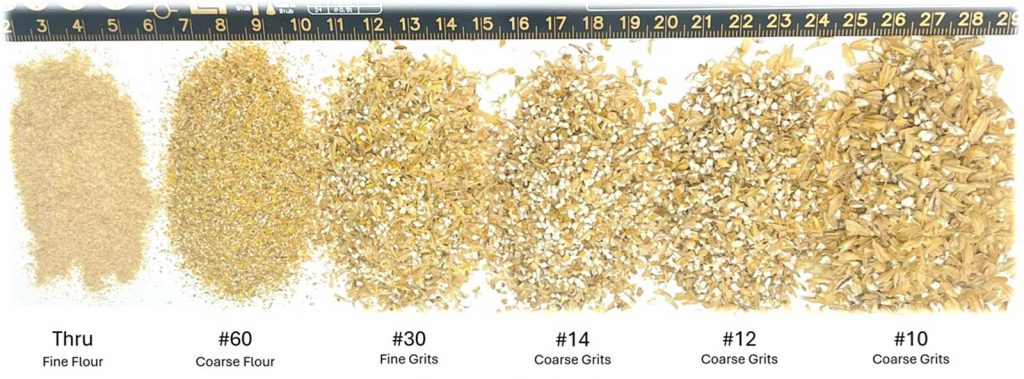
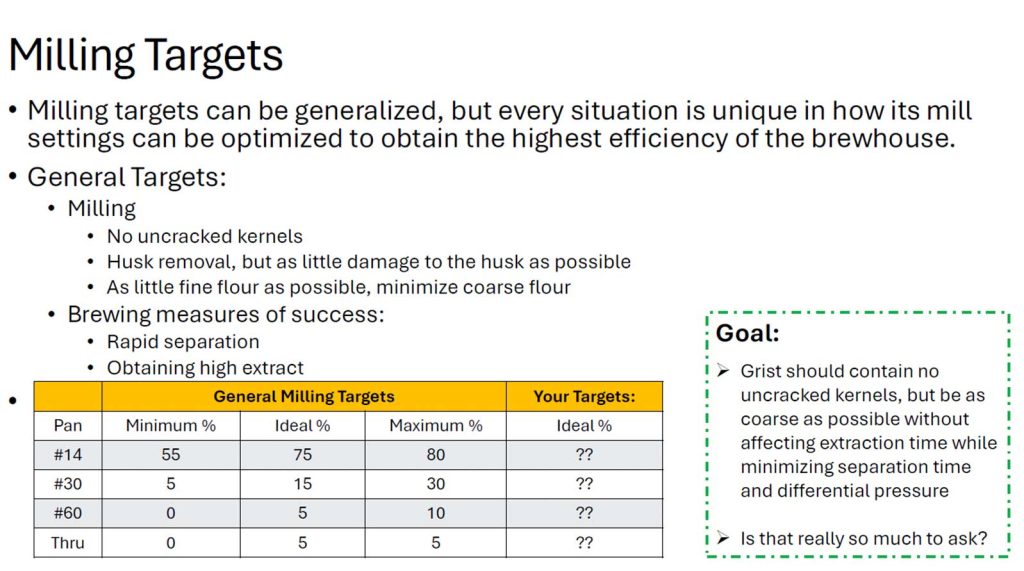
The particles created in the mill form the structure of the filter in lautering, ultimately determining how well the filter functions. For lautering to be rapid and trouble-free, milling must be consistent, adjustable, and measurable. The ability to optimize milling is dependent on the equipment being used, the number of rollers, roller fluting, sieves, feed rate, and how they can be adjusted. We don’t have time to talk about all things milling here, but often the most significant adjustment you can make is changing the space between the mill rollers, called the gap. Unfortunately, there is no standard value for optimal mill gap settings. That measurement is unique to the manufacturer and style of the mill, as well as the functionality of the brewhouse.


Complicating matters further is that mill gap settings cannot be based on the particle profile alone; they must be correlated and adjusted according to successful separation during lautering. Much like observing grain handling, visual observations are good, but measurements are better. We utilize a Ro-Tap assessment (ASBC Malt-15) in our 500bbl brewhouse as well as our Insta Grains facilities to ensure we are achieving the desired particle profiles. Adjustments are made to the mill gaps based on results that have been correlated to successful wort separation. In addition to particle size distribution, it is essential to look closely at the husk material after milling. If it has been shredded or slivered, it will have diminished ability to create a porous, springy grain bed, significantly affecting the characteristics of the filter bed. With all these variables, the desired level of crush can be significantly different between breweries, even with similar equipment.
If you’re milling directly into the mash, your dry handling concerns are over at this point. If not, you should also be concerned with the handling system after milling. Gentle conveyance after milling is just as important because milled grist particles are more susceptible to breakage than whole kernels are. In the worst case I have seen, the amount of flour and other small particles increased by over 10% before mashing in. In that case, a worn screw auger was essentially milling the grain, after milling the grain.

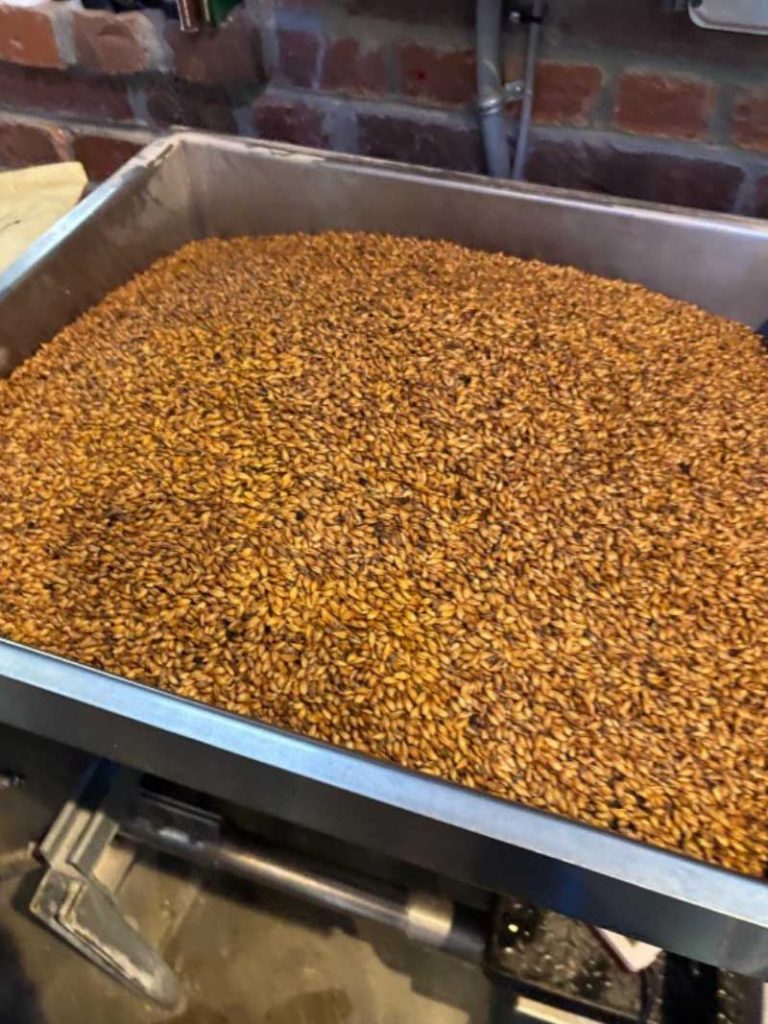

and Levante Brewing.
Wet conveyance and agitation are other commonly overlooked considerations when a difficult lauter occurs. Pumping and mixing can significantly affect both the particle profile and husk quality of the hydrated grist. High shear conditions created by impellers and mash mixers can considerably shift the particle size distribution by breaking large particles and damaging husk material. After mashing in, this damage can be very difficult to see, and almost impossible to quantify using the tools typically found in a brewery. Limiting the use or optimizing the speed of mash mixers will help preserve the integrity of the grist. Proper maintenance and appropriate pump speeds may also help reduce damage, but neither of these adjustments can prevent it entirely.

Separation
Once you have made it to the lautering process, the battle is not yet over. Even when you have the optimal process to the point of separation, you can operate the lauter tun (or mash-lauter) in a way that creates difficult or slowed conditions.
The conditions in your separation vessel are complicated; the process is best described using Darcy’s Law, and if you’re into fluid dynamics, that’s the equation for you. If you don’t want to delve too far into science, you can still make a few simple measurements to better understand how well your process is performing. Once you establish the typical conditions, you can start to adjust increase separation speed and overall throughput. The quality of your filter can be difficult to quantify, but one parameter most brewers can measure is grain bed depth. Measuring from a known point in your lautering vessel to the top of the grain bed, then comparing that measurement to the distance to the false bottom in the vessel gives you the depth.
You can take that value a step further if you’re so inclined, combining this measurement with the volume of your vessel and the weight of your grain bill to create a density value for your filter bed. Over time, you can establish a standard value or range where you expect to achieve success.
Viscosity
In addition to the quality of the filter, viscosity is a factor that has a direct effect on the separation process, but a viscometer isn’t a common tool at most breweries.
Thankfully, temperature and wort strength are two variables that contribute directly to viscosity, and I haven’t been to a brewery without a thermometer and hydrometer. The stronger and cooler the wort is, the more viscous it becomes. The ability to heat, or at least maintain the wort temperature during separation, can help make process flow easier.
The collection speed is another factor that can directly cause a lauter to fail. If the speed is slow, you’re making your day unnecessarily longer. But as speed increases, the pressure on the filter bed increases. If the pressure becomes too high, it can cause the bed to collapse, and a stuck run-off will make for an incredibly long day.
Running the collection slower, when the viscosity is highest (as with strong worts), will limit the pressure and potential collapse of the bed. With sparging, the wort strength will drop, and so too will the viscosity, allowing for collection rates to be increased. It is not uncommon for run-off rates to be three times higher at the end of collection than at the start – start slow, be patient, and play catch-up as solids/viscosity come down!

Differential Pressure
Frankly, measuring the pressure exerted on a filter bed sounds complicated, best explained to me by someone wearing a lab coat in front of a chalkboard. But it can be done in a fairly simple way utilizing a differential pressure tube (or, if you’re so inclined, by purchasing an inline meter).
This method demonstrates the pressure exerted on the bed by showing the pressure under the false bottom, compared to the wort level in the vessel (see below).

Measuring the difference in the two levels reveals the differential pressure exerted on the filter. A larger difference means that the filter has more pressure exerted on it. Once you can measure and observe the differential pressure using your typical lautering process and collection rate, you can evaluate how it changes with adjustments.
Be diligent and realistic when adjusting your collection rate, as difficult conditions may not immediately reveal themselves, and a hasty adjustment can irreparably damage the grain bed. Observing the differential pressure can be one of the best ways to understand if you can, or should, adjust the rate of wort collection. When you start to compare lautering data, in combination with specific recipes, and the grist profile from the mill, you can start to identify trends and optimize your process.
Most brewers know that simply knowing how much beer you’ve made, from how much malt you have consumed, is entry-level information. There is a metric ton of information that can be collected in the brewing process that can lead to increased efficiency and process optimization. Collecting not just more, but better data and relating that to the success of the process is key. If you are interested in assessing and optimizing your process, one of the best places to start is your maltster. Here at Briess, we have many tools to help you get started and are happy to work with you to set the bar for success.